News
PX Is Title Sponsor of LeadsCon 2025
PX returns as title sponsor of LeadsCon 2025 at MGM Grand, Las Vegas, April 7-9.
Industry leaders predict how AI, automation, and connected data will reshape lead generation by 2030.
PX has conducted its annual State of the Industry survey for the past seven years to capture how lead buyers, sellers, platforms, and intermediaries view the market.
This year’s findings were gathered from performance marketers across more than 25 industries and presented during the opening keynote at LeadsCon, along with a panel discussion with Amy Zimmerman, CMO at Florida Window & Door; Robin Spencer, COO at Faraday; Matt Curtis, VP of Strategic Initiatives at American Residential Services; and Jeff Piotrowski, Chief Customer Success Officer at CSG. The conversation added a practitioner layer to the data, showing how leaders across the industry are interpreting the findings inside their own lead-buying, selling, data, and customer engagement operations.
Several themes stood out. The industry remains optimistic, but lead buyers are under more pressure to prove profitable growth. Lead sellers and buyers often view performance from different points in the journey. AI is gaining attention, but better data must come first. And by 2030, the definition of a lead is expected to become richer, more contextual, and more closely tied to what happens after the handoff.
The survey data shows that 60% of the industry feels optimistic. Lead sellers are about 50% more optimistic than lead buyers. Home services, auto insurance, and mortgage are more optimistic than average, while overall confidence has declined compared to previous years.
.png?width=3125&height=2375&name=SOTI%20Blog%202026%20Graphics%20(3).png)
Robin Spencer connected this shift to the speed of change in the industry. AI is no longer limited to early or surface-level use cases. It is beginning to influence how companies think about core buying, selling, and operating use cases.
Jeff Piotrowski brought a perspective from the auto insurance industry. The category looks strong on paper, with higher spend and transaction volume across parts of the market. But he also raised a concern: higher ad spend does not always translate into profitability. If the budget comes back without the right performance discipline, the market can repeat earlier profitability issues.
Amy Zimmerman grounded the discussion in the reality of a competitive home services market. At Florida Window and Doors, hurricane windows are a highly competitive category, and she has seen lead costs rise significantly. Her point was direct: marketers cannot keep spending more and waiting for performance to improve. When a campaign is underperforming, delay can become expensive.
Matt Curtis connected the same pressure to the wider media mix. Lead generation competes with search, local, affiliate, and other acquisition channels for budget. With changes in Google’s local map packs and AI overviews, lead buyers are watching where they can get the strongest return and where they need to reduce concentration risk.
Lead buyers and lead sellers see the market differently because they often measure success at different points in the lead journey.
The survey data shows that 28% of lead buyers are missing their ROI targets by an average of 1x. At the same time, 88% of lead sellers believe they are helping buyers hit their goals, and 60% of sellers say they are receiving higher prices than last year.
Seller profitability is healthy for the market, but the economics must also work for buyers. If buyers cannot make the numbers work, that imbalance will eventually affect both sides. This is where partnership becomes important. Sellers can only help improve performance when buyers share accurate, up-to-date data.
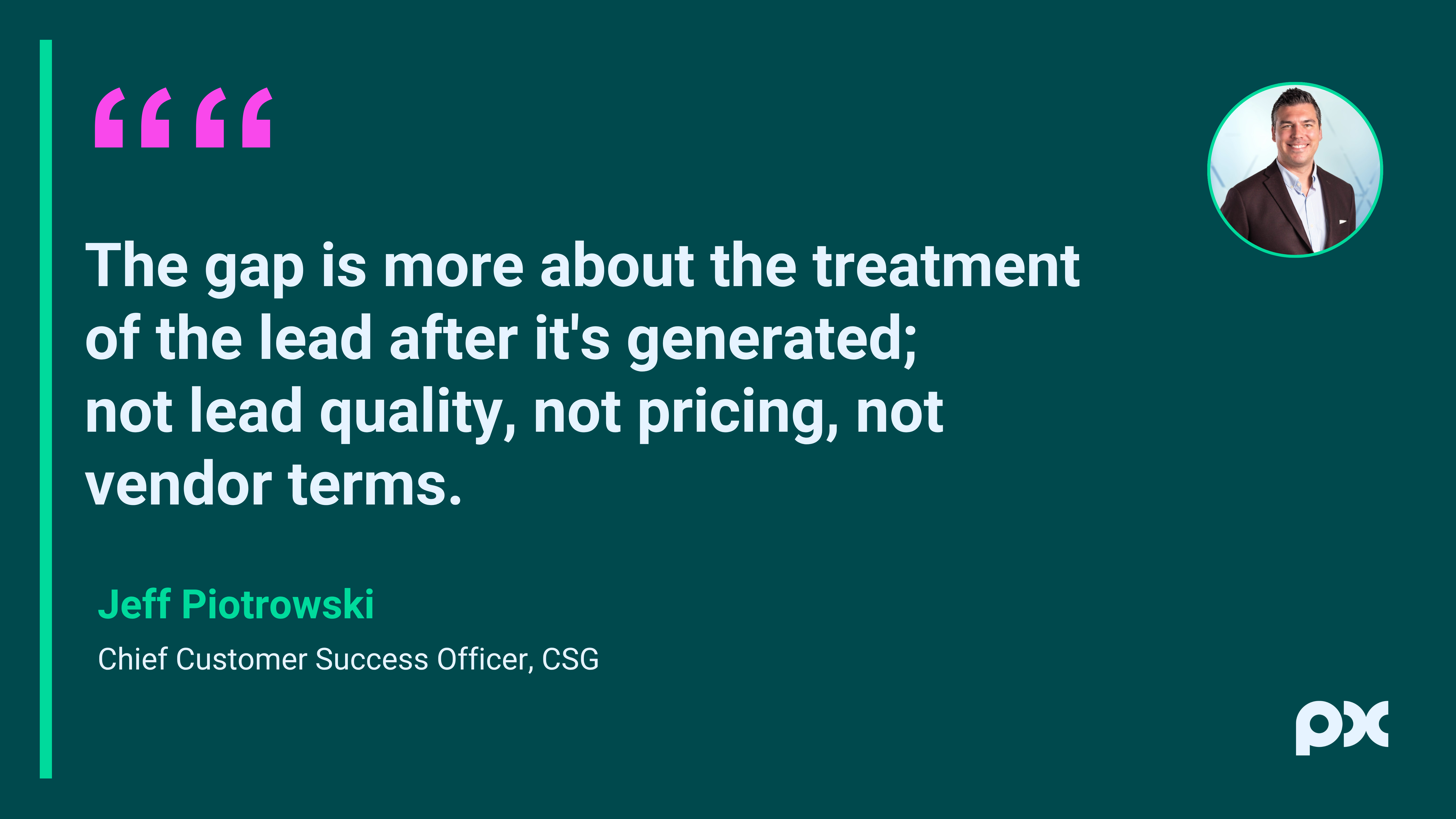
There is also a key operating point behind the gap. Sellers can provide high-quality leads, yet buyers still miss ROI targets. The same lead ID can produce very different outcomes for different buyers, which means the performance gap may come from what happens after the lead is generated, sourced, and routed.
This broadens the conversation beyond lead quality alone.
Speed to contact, routing, call handling, follow-up consistency, sales process, and feedback loops can all affect the outcome. A lead can meet quality expectations at delivery and still lose value later if the handling process is inconsistent.
What does control mean for lead buyers today?
For lead buyers, control means having sufficient visibility, lead-source choice, performance data, and budget flexibility to make decisions faster.
The survey data shows that 73% of lead sellers feel in control of their campaigns. Only 30% of lead buyers feel the same. Pricing is still heavily negotiated manually, even though many other media channels have moved toward more automated budget and pricing management.
.png?width=3125&height=2375&name=SOTI%20Blog%202026%20Graphics%20(4).png)
That control gap matters because lead buyers have fewer ways to respond when performance changes. The control usually comes down to three levers: what buyers pay for a lead, how they allocate budget, and how many qualified lead sources they can choose from.
Source optionality strengthens all three. It means you have access to a broader mix of qualified lead sources rather than relying on a limited set of partners. With a broader mix of qualified sources, buyers can compare performance across partners, shift budget toward what is working, and make more informed pricing decisions. Without it, they are more dependent on the sources already in place and have fewer ways to respond when volume, quality, or ROI shifts.
Matt Curtis shared that ARS works with around 50 lead sources, managed by one person. That example shows what becomes possible when lead source management is supported by automation rather than by manual budget changes and one-off negotiations.
The data also supports this pattern. Successful lead buyers are 2.3x more in control than buyers missing ROI targets. They are more likely to have campaign management automated. They also work with 4x more lead vendors or lead sources.
The broader market is moving in a different direction. The average buyer now works with 15 lead sources, the lowest number measured in four years. Last year, that number was 33. At the same time, the average team size for managing lead generation is 10 full-time employees, and 60% of lead buyers agree that this is not the ideal team size.
.png?width=6000&height=3375&name=SOTI%202026%20Blog%20Quote%20Cards%20(1).png)
Where should lead buyers start with automation?
The survey data show that automation remains limited across lead-buying operations: 65% of lead buyers report low automation in campaign management, while successful buyers have automated about 50% of their operations.
That makes the starting point clear: automation should first focus on the parts of the operation that slow down decision-making and create reporting delays.
High-effort internal work, such as reporting and analytics, is a practical place to start. These are areas where people spend significant time collecting, comparing, and interpreting data.
AI can reduce that effort and help teams test, adjust, and improve faster, but it depends on the quality of the data it's built on. Before teams move into advanced AI use cases, they need a clear view of which sources are performing, which leads are converting, how campaigns are tracking against goals, and what happens after the lead is worked. That is the operating layer AI needs before it can support decisions around scoring, routing, budget movement, and next-best action.
.png?width=6000&height=3375&name=SOTI%202026%20Blog%20Quote%20Cards%20(2).png)
The survey findings show that AI is already having a major impact on the lead buying lifecycle, but the industry is not moving toward full automation all at once.
45% of respondents feel the industry has not adapted well to developments in AI and technology. At the same time, 60% expect automation to play a moderate or helpful role, while 20% expect it to play a major or significant role.
The use cases are also becoming clearer. For lead buyers, the top AI use cases are extracting insights from sales conversations, qualifying leads before handing them over to sales, monitoring compliance and raising alerts, choosing or ranking lead sellers, and forecasting results and trends.
For lead sellers, AI is expected to support buyer prioritization, lead distribution logic, traffic allocation, compliance and consent monitoring, and insights from consumer feedback.
These use cases show that AI adoption is being discussed around specific operational needs rather than full replacement of existing workflows.
Looking ahead, 36% of respondents believe AI will become the leading contact method and reduce phone contact. Also, AI-powered search and discovery is a top emerging channel for both lead buyers and lead sellers over the next five years.
The survey data shows that 52% of respondents expect every lead to carry significantly more context and information.
.png?width=3125&height=2375&name=SOTI%20Blog%202026%20Graphics%20(7).png)
That shift changes what a lead needs to represent. Lead data needs to reflect how consumers want to engage, not only how companies want to capture them. Some consumers may prefer a form, while others want to call, chat, book online, or get help after hours. The lead buyer’s role is to quickly understand the intent and move the consumer toward the right next step.
This also changes what happens after the lead is captured. If a consumer starts through one channel and moves to another, the information they already shared should carry over. A stronger lead journey depends on continuity across touchpoints, so the consumer does not have to repeat the same information at every step.
Richer lead data can help companies personalize the journey without making the experience feel intrusive. The goal is to use context to understand the consumer's needs, how they prefer to engage, and which next step is most relevant, while keeping the experience respectful and transparent.
By 2030, lead generation is likely to be more connected across data, buying decisions, lead treatment, and consumer experience.
Amy Zimmerman focused on the full lead-handling process: speed-to-lead, call handling, after-hours response, AI voice, texting, online appointments, and nurturing. Her view was that the next few years would show what consumers accept across AI voice, text, calls, and automated booking.
Robin Spencer described a future where leads are treated more like consumers again. Data and AI can help create a more personal journey, as long as the experience respects the person behind the lead.
Matt Curtis focused on getting the right consumer to the right sales experience and the right technician, supported by connected data. For a company like ARS, that means linking the lead buying decision to what happens later in the home.
Jeff Piotrowski focused on transparency and consumer agency. By 2030, he wants lead buyers, and sellers to share the data needed to improve journeys while giving consumers more clarity about how their information is used.
Together, these views point to a more connected lead generation model. Buyers will need more control. Sellers will need better feedback. AI will need better data. Consumers will expect faster and more consistent experiences.
The companies that move ahead will be the ones that connect the full journey from source to outcome.
The main takeaway was that the future of lead generation will depend on lead buyer control, stronger data architecture, automation, richer lead context, and better consumer experiences.
Lead buyers are under more pressure because lead costs are rising, ROI targets are harder to hit, campaign management remains manual in many organizations, and lead buyers often feel less control over pricing, source mix, and down-funnel performance.
Successful lead buyers are using more automation, working with more lead sources, and building systems that help them compare performance, move budget, and act faster.
.png?width=3125&height=2375&name=SOTI%20Blog%202026%20Graphics%20(5).png)
AI can support reporting, scoring, routing, outreach, and personalization. The panel made clear that AI needs clean and connected data before it can create real value.
A lead is expected to include more context, such as intent, source, consent, channel preference, journey history, urgency, and signals that help lead buyers decide on the best next action.
Transparency will matter more because lead buyers need better performance data, sellers need feedback, and consumers need clarity about how their data is being used. As automation grows, trust will depend on that visibility.
For more insights from the State of the Lead Gen Industry Report 2026, download the full report.
Watch the actual recording of the LeadsCon keynote panel, where all of the above and more were discussed.
PX returns as title sponsor of LeadsCon 2025 at MGM Grand, Las Vegas, April 7-9.
Inconsistent home services lead quality often comes from blended sub-sources, poor routing, and resold leads.
Visit PX at LeadsCon 2024 in Las Vegas, April 8-10, at Booth #603.