What is lead verification?
Lead verification is the process of checking a lead record against third-party data before you pay for it or call it. A complete check answers three questions: was consent captured and documented, did the phone and email reach a real person, and does the person behind the record fit the offer well enough to convert.
That third question is enrichment rather than verification in the strict sense, and it belongs in the same decision. A lead can be fully consented, fully contactable, and still worth very little to you if the household cannot afford the product or does not own the home your offer requires. Buyers who evaluate consent and contactability separately from fit end up paying full price for leads that were never going to close.
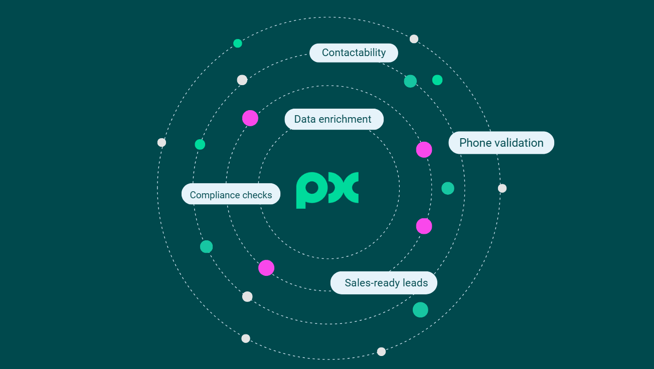
Wrong numbers, expired consent, duplicate submissions, and half-filled forms all slip in and quietly cost time and money. PX checks every lead before it enters your campaign, connecting you to trusted providers that clean, score, and flag the data in real time.
The three layers of a verification stack
Layer 1: Consent and TCPA. Proof that the consumer agreed to be contacted, and confirmation that the consumer is not a known litigator or on a suppression list.
Layer 2: Contact data. Whether the phone number connects and the email address accepts mail.
Layer 3: Data Enrichment: Appends trusted third-party data to a lead record to judge fit rather than confirm the lead is real. It adds signals like income, credit, and homeownership, so you can score whether a consented, contactable lead is worth pursuing before purchase.
Layer 1: Consent and TCPA compliance
1. Jornaya LeadiD (InfutorData)
- What it verifies: Consumer behavior across the journey rather than a single page view, including how long the form took to complete, how many times a lead ID has been registered, and how the consumer moved between sites before submitting.
- The failure it catches: Duplicate and recycled leads, and submissions where the behavioral pattern looks automated rather than human.
- When to add it: When your volume is high enough that duplicate detection and journey data change your bidding, or when a partner contractually requires a LeadiD token.
- Set up everywhere: A token travels with the lead and gets authenticated against Jornaya at ingest. In PX, the Jornaya authenticity filter is configured per lead campaign, and publisher-side traffic can be set to a specific percentage for verification
- One thing to watch: Following the January 2026 acquisition, Trusted Form and LeadiD sit under one corporate owner.
- What it verifies: Whether a phone number belongs to a known TCPA litigator or serial claimant.
- The failure it catches: The single lead that costs more than a year of media spending.Litigator scrubbing is insurance against a plaintiff who submits forms specifically to generate claims.
- When to add it: Before your first outbound dial, at any volume. This is one of the few checks where a hard reject is the right call rather than a bid adjustment.
- Set up everywhere: In PX the filter runs per campaign, and blacklisted or suppressed results can be rejected automatically before the lead is routed. It also works in the other direction: a publisher who sees the result can identify and block the source rather than being pulled into the claim.
3. DNC.com (Contact Center Compliance)
- What it verifies: Numbers against the federal Do Not Call registry, state registries, wireless identification, and internal suppression lists.
- The failure it catches: Calls to numbers you were never permitted to dial, including state list obligations that many buyers track less carefully than the federal registry.
- Set up everywhere: As soon as you dial across multiple states, state level requirements vary, and several have tightened.
- How it integrates: API scrub at ingests plus scheduled batch scrubs of your existing database.
Layer 2: Contact data validation
- What it verifies: Number formatting and routability, line type, carrier, and optional caller name, returned from Twilio's carrier data.
- The failure it catches: Leads submitted with disposable VoIP numbers, and numbers that will never connect regardless of how many times a dialer tries.
- Set up everywhere: When SMS is part of how you work leads. Line type decides whether a text can be delivered at all, so sending landlines and misclassified numbers of burns messages and damages your standing with carriers, which then affects delivery on every message after it. Line type is also the check worth running immediately before a send rather than only at ingest, because numbers get ported and reassigned in the gap between buying a lead and working it.
- How it integrates: A single API call per number, with optional data packages for line type and caller name.
- What it verifies: Trestle's Real Contact API returns a phone activity score indicating whether a number is connected, a name match confirming the phone or email belongs to the person who submitted it, line type across seven categories, and a contact grade for phone and email.
- The failure it catches: A number that is technically valid and technically connected but belongs to someone other than the name on the lead.
- Set up everywhere: When your contact rates vary widely across sources that look identical on paper.
- How it integrates: API call at ingests, with batch upload available. Most lead platforms and dialers support it directly.
- What it verifies: Whether an email address exists and will accept mail, and whether it is a role account, a disposable domain, or a spam trap.
- The failure it catches: Bounces that damage your sending reputation, plus the throwaway addresses that signal a consumer who never intended to hear from you.
- Set up everywhere: Once email is part of your follow-up sequence rather than an afterthought. A single spam trap hit affects deliverability for every subsequent send.
- How it integrates: Real-time API at form submission or lead ingest, plus list cleaning for existing databases.
- What it verifies: Whether a phone number is currently connected, using real-time carrier and phone switch data, and returns line type, carrier name, and do-not-call status.
- The failure it catches: Dials that were never going to be completed. Real Phone Validation reports that 42% of numbers in aging, batch-validated contact lists came back disconnected, which is the cost of data decay on any list that sits before it is worked. The company also reports a weekly QC process testing at least 2,000 randomly selected numbers, with 92% accuracy on connected results and 99% on disconnected ones.
- Set up everywhere: Connection status is a hard signal, so a reject here is defensible.
- How it integrates: PX runs a real phone validation check on lead and data campaigns by default, filtering disconnected numbers before delivery.
Layer 3: Data Enrichment
- What it verifies: Appends premium economic and financial signals through the RRDB API, including household income, spending, credit scores, affluence ratings, and homeowner status.
- The failure it catches: Leads with solid contact data but weak financial fit, like a renter in a homeowner-only offer or a low-credit lead in a credit-sensitive vertical.
- Set up everywhere: In verticals where affordability or homeownership decides fit, such as home services, solar, mortgage, or insurance.
- How it integrates: Runs lead entry through the RRDB API in your PX workflow.
- What it verifies: Enriches each record with over 1,400 consumer data points to build audience segments, sharpen targeting, and personalize the acquisition journey.
- The failure it catches: Thin records with no context for segmentation or prioritization, and one-size-fits-all outreach that ignores who the lead is.
- Set up everywhere: When you want smarter segments and personalized outreach in high-volume consumer verticals.
- How it integrates: Connects by API at lead entry, with appended attributes flowing into PX segmentation, scoring, and routing.
- What it verifies: Adds ZIP+4 based demographic and financial indicators, including contactability scores and financial health assessments.
- The failure it catches: Records with no read on financial health or reachability, which leads to misrouted or low-value outreach.
- Set up everywhere: In finance-sensitive verticals like insurance and financial services, or anywhere affordability signals shape routing.
- How it integrates: Runs as a real-time ZIP+4 lookup by API at entry, feeding demographic, financial, and contactability signals into your PX workflow.
- What it verifies: Adds ZIP+4 based demographic and financial indicators, including contactability scores and financial health assessments.
- The failure it catches: Records with no read on financial health or reachability, which leads to misrouted or low-value outreach.
- Set up everywhere: In finance-sensitive verticals like insurance and financial services, or anywhere affordability signals shape routing.
- How it integrates: Runs as a real-time ZIP+4 lookup by API at entry, feeding demographic, financial, and contactability signals into your PX workflow.
|
Service
|
Layer
|
What it checks
|
Best suited to
|
|
Jornaya LeadiD
|
Consent
|
Form-fill behavior, duplicates
|
Any buyer contacting leads outbound
|
|
The Blacklist Alliance
|
Consent
|
Known TCPA litigators
|
Any buyer dialing outbound
|
|
DNC.com
|
Consent
|
Federal, state, internal suppression
|
Multi-state calling operations
|
|
Real Phone Validation
|
Contact data
|
Connection status, line type, carrier
|
High dial volume, aged or batch lists
|
|
Twilio Lookup
|
Contact data
|
Routability, line type, carrier
|
SMS-led follow-up
|
|
Trestle
|
Contact data
|
Phone activity, name match, contact grade
|
Unexplained contact rate gaps
|
|
BriteVerify
|
Contact data
|
Email deliverability, traps, disposables
|
Email-led follow-up
|
|
RRDB
|
Enrichment
|
Income, credit, affluence, homeownership
|
Homeownership or credit-gated offers
|
|
Faraday
|
Enrichment
|
1,500+ consumer attributes, segments
|
Segmentation in high-volume verticals
|
|
TransUnion
|
Enrichment
|
ZIP+4 demographics, contactability, credit
|
Insurance and financial services
|
The case for centralizing your lead verification services
Ten verification services mean ten contracts, ten integrations, and ten things that can time out. Three problems follow, none of them about vendor quality.
- Sequencing what you pay for. Every lookup bill whether the lead survives or not. Enrich a record for income and credit, then reject it on a litigator's match, and you paid to describe a lead you were never allowed to call. Cheap disqualifying checks belong before expensive descriptive ones and getting that order right across separate vendors means building the orchestration yourself.
- Latency. A ping post decision window runs in hundreds of milliseconds. Six sequential vendor calls from your own middleware to spend it before you have made a bid.
- No single answer to why the lead failed. Six vendors return six formats, so teams end up knowing their reject rate without knowing what drives it.
PX runs these checks at the campaign level instead. Rejections resolve to one result code in one report (Phone Unreachable, Jornaya Authenticity Failed etc.), checks run before delivery, so a failed lead never bills, and enrichment from TransUnion, RRDB, and Faraday lands in the same flow.
Not sure which checks your campaigns need? Our team of specialists can help you decide based on your goals, lead sources, compliance needs, and sales team capacity.
Contact our team today
