What is lead acquisition budget waste?
Lead acquisition budget waste is the portion of marketing spend lost to inefficiencies during the process of generating, buying, routing, or managing leads. This leads to low contact rates that carry a real cost: agent time gets wasted on leads that will never convert, dialer capacity is consumed, and relationships with lead vendors suffer as performance declines.
In lead acquisition, budget waste is not always tied to poor campaign management. Many times, it comes from gaps inside the acquisition infrastructure itself. A lead may be routed too late, accepted without proper verification, or sold multiple times without enough controls in place.
These issues create unnecessary costs across the marketing funnel and reduce overall acquisition efficiency. For marketers, they are rarely isolated incidents. Over time, they become recurring operational costs built into how campaigns run.
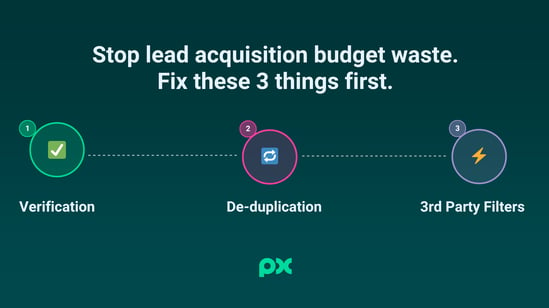
Below, we break down 3 areas where marketing budget tends to quietly drain away, and how you can address each one.
1. What is lead verification, and why does it reduce wasted spend?
Paying leads that cannot be contacted is the most direct form of budget waste. Research shows that without a validation layer in place, 15–30% of leads contain invalid or fraudulent contact data. (LeadGen Economy, 2025)
Taking this into consideration, the verification process needs to happen before a lead is accepted, not after it fails to convert. A complete verification layer covers phone validation, email confirmation, contactability filters, credit and fraud signals, compliance checks, and many more. Feedback loops tied to these lead outcomes close this step, giving all parties involved the data needed to refine filters.
Some use cases and examples from industry-leading verification services integrated with campaigns managed on the PX platform:
- Filter out 95% disconnected phone numbers before they hit your CRM/ dialer through Real Phone Validation
- Check each lead’s contactability score through Trestle, going beyond whether a phone number is active to assess how likely a lead is to pick up.
- Protect your brand from serial TCPA litigators and plaintiffs with dnc.com and Blacklist Alliance. In regulated industries (e.g., Medicare), one bad lead can cost the brand millions in lawsuits and litigation.
- Append household financial data with RRDB Live and spend money on the leads that better fit your ICP.
- Ensure lead data is valid and legitimate by flagging leads with profane and bogus PII with Profanity Filter.
2. How does lead de-duplication prevent paying for the same lead twice?
The industry average shows that 15–17% of leads are duplicated within a 30-day window, meaning a $100,000 monthly vendor budget. Marketing teams can lose between $15,000 and $17,000 depending on the industry and the scale of the marketing budget.
This can be handled through buyer-level de-duplication logic at the ping stage, best applied at both the email and phone number of the lead to prevent the same lead from entering your tech stack.
One example of this strategy is a home remodeling partnership managed on the PX platform over three years. Buyer-level deduplication applied at both the email and phone number level recovered $627,703 in a combined budget that would have otherwise been spent on records already worked.
Email deduplication alone saved $26,713. Phone deduplication delivered the larger share of savings, recovering $600,989. The outcome benefited both sides: buyers avoided paying for leads they had already worked, and lead sources maintained quality standards that build long-term trust.
Home Services faces some of the highest duplication rates, driven by the volume of leads in play and the heavy presence of aggregated traffic sources. A consumer requesting a roofing quote, for example, may submit the same form across three or four aggregator sites within minutes.
What PX also enables beyond blocking duplicates is using them as a signal. A duplicate appearing in the marketplace can mean the consumer is still shopping, actively comparing options, or exploring additional services. PX surfaces these signals through API transactions or daily reports, giving brands the visibility to re-engage those consumers for retargeting or cross-selling. The savings recovered from deduplication go directly back into budget, allowing marketers to buy more leads within the same spend and take greater control over campaign performance.
3. How do lead filters stop you from buying leads you cannot service?
Not all budget waste comes from bad data or duplicate records. A significant portion comes from buying leads that were never going to convert, not because the contact information was wrong, but because the lead simply did not fit.
Filters solve this at the point of purchase. Brands can set granular targeting rules that define what a qualifying lead looks like before a single dollar is spent. A lead that comes overnight when no agent is available is worth less, so day-parting rules stop leads from entering the queue outside call center hours. If a business operates Monday through Friday from 8 am to 4 pm, the budget is only spent during those windows.
The same applies if a business only operates with specific zip codes; leads outside those areas are never bought. The more granular these filters are, the more directly they influence lead bid decisions and overall acquisition efficiency.
In Medicare, for example, policies can only be sold to consumers aged 60 and older, meaning an age filter eliminates non-qualifying leads, protecting both budget and compliance. In home services and solar, filters on homeowner status, utility bill thresholds, and property type narrow the pool to leads that match what the business sells.
Filters are not just a cost-cutting tool. The best approach is a balance between protecting the budget and maintaining enough volume to scale. On PX, additional filters expand this capability beyond what is collected on the lead form itself, pulling in third-party data to refine the lead profile with attributes a buyer may have otherwise never had access to.
What happens when verification, de-duplication, and 3rd party filters work together?
These three processes work best when combined as a system. Fixing one in isolation reduces waste at the margins, but connecting verification, deduplication, and 3rd party filters is where the real efficiency gains are, and where the pipeline gets cleaner.
At PX, that integrated model is the standard operating setup. Instead of managing verification, deduplication, and filters individually across disconnected systems, brands can manage all their marketing campaigns through industry-leading verification service providers, deduplication logic, and granular targeting filters, all in one platform.
If you want to explore where your current setup is losing budget, our team of experts is happy to walk you through some best practices.
Convert More Leads.
Convert More Business.
